Scouting History
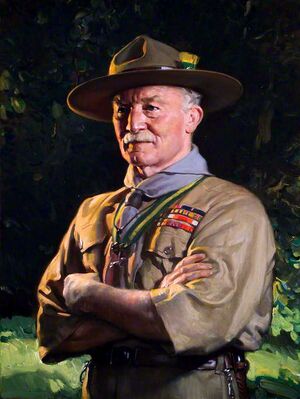
The Scout Movement was founded in 1907 by Robert Baden-Powell, a decorated lieutenant-general in the British Army who became a national hero after defending the town of Mafeking during the Second Boer War. Drawing inspiration from his military experiences, survival handbooks, and outdoor skills training, Baden-Powell organized a small experimental camp on Brownsea Island in Dorset, England, to test his ideas with a group of 20 boys from diverse social backgrounds..
-
1907
The origins and Brownsea Island
- A military manual becomes a youth guide. Baden-Powell returned from the Boer War as a national hero after the Siege of Mafeking. He discovered that his military training manual, Aids to Scouting, was unexpectedly popular with young boys and teachers in Britain.
- The first experimental camp. From 1 to 9 August 1907, Baden-Powell brought 20 boys from different backgrounds, a mix of public school pupils and boys from local working-class Boys’ Brigade groups, to Brownsea Island in Poole Harbour, Dorset. Split into four patrols (Wolves, Ravens, Bulls and Curlews), they tested his ideas on camping, tracking, knotting, woodcraft and teamwork.
-
1908–1910
Rapid expansion and Scouting for Boys
- The book. After the success of Brownsea Island, Baden-Powell published Scouting for Boys in six fortnightly instalments in 1908. It became an instant bestseller, and is said to have sold over 100 million copies.
- Spontaneous growth. Boys across the country formed their own unofficial patrols. By 1909, over 11,000 Scouts attended a rally at the Crystal Palace in London.
- Girls demand entry. At the 1909 Crystal Palace rally, a group of girls approached Baden-Powell demanding to be Scouts too. This led him to found the Girl Guides in 1910 with his sister Agnes, and later his wife, Olave.
-
1916–2021
Expanding the age groups
To cater for younger and older members, new sections were introduced over the years:
Wolf Cubs · 1916For boys aged 8 to 10, themed around Rudyard Kipling’s The Jungle Book. Now known as Cubs.Rovers · 1918Established for young men aged 17 and older.Beavers · 1986Officially introduced in the UK for 6 to 8-year-olds.Squirrels · 2021Launched in the UK for 4 and 5-year-olds to support early childhood development. -
1914–1945
Wartime service and the home front
- World War I and II. Scouts played key roles supporting the home front in Great Britain. They served as coastguards, messengers, fire-watchers and stretcher-bearers during the Blitz, and helped gather harvests and salvage materials.
-
1976–today
Modernisation and inclusivity
- Co-education. Girls were first admitted to the senior section (Venture Scouts) in 1976 and to all age sections in 1991. Since 2007, all UK Scout groups have been fully co-educational.
- Global impact. Today, Scouting is active in almost every country in the world, with over 57 million members worldwide belonging to the World Organization of the Scout Movement (WOSM).
14th Applemore History
14th Applemore Scout Group was founded in 1968 and has been bringing adventure, fun and life skills to young people across our local community ever since.
-
1968
The group begins
Add the story of how the group started here: who set it up, where it first met and how it grew.
-
Add year
Add a milestone
Add a camp, a new section, a move to the hut, an anniversary or anything else worth remembering.
Be part of the next chapter
14th Applemore Scout Group has been part of this story since 1968. Come and join us.
Find out how to join